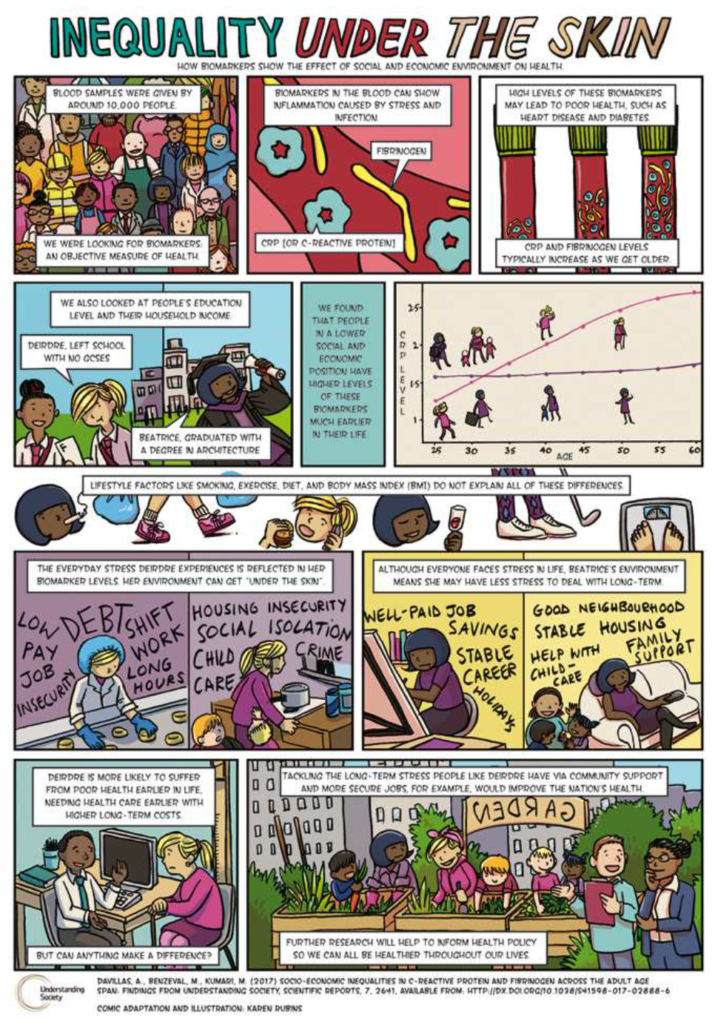
Understanding Society collects information about participants’ social and economic circumstances, attitudes and beliefs and it also gathers information about their health. From Wave 1 onwards participants were asked a number of questions about their general health. In Wave 2 and Wave 3 adult participants received a follow-up health assessment visit from a registered nurse.
Biomarkers
A range of bio-medical measures were collected from around 20000 adults, which included blood pressure, weight, height, waist measurement, body fat, grip strength and lung function. Blood samples were also taken at these visits and frozen for future research. A number of biomarkers have now been extracted from the blood which measure major illnesses in the UK as well as being markers of key physiological systems.
Proteomic data
Proteomic panels have been created that focus on proteins for cardiometabolic health and neurological processes. In total, 184 proteins were measured in 6,180 adults. The proteins in the cardiometabolic panel are known to be involved in processes related to cardiovascular health (i.e. of the heart and blood vessels) and metabolism (i.e. the processing of molecules such as nutrients and drugs). It is anticipated that the cardiometabolic panel proteins in this dataset will provide further insights into the pathways to, and points of intervention, for cardiovascular disease. Many of the proteins for the neurology panel are well-known to have roles directly related to the health and disease of the nervous system, while others may be more indirectly related. A description of all the proteins included in the proteomic data can be found in the specific User Guide.
Epigenetic clocks
Epigenetic clocks, constructed based on CpG sites whose DNAmethylation levels are associated to chronological age or age-related health outcomes, have attracted a lot of research interest for their potential to quantify rates of biological ageing. The difference between a person’s chronological age and epigenetic age calculated by these ‘clocks’ has been used as an indicator of whether an individual is aging faster or slower biologically than expected, given their actual age. Differences between actual age and biological age may be related to life circumstances and environment. For the Understanding Society data, five epigenetic clocks have been constructed. You can read more about epigenetic clocks in the User Guide.
Polygenic scores
A polygenic score is a continuous variable that reflects an individual’s propensity towards a given trait. These traits can include disease status, behaviours, and blood levels of biomolecules, among many others. A number of polygenic score variables have been derived from the genomic dataset and are available for the first time in the Special Licence version of the Nurse Assessment dataset (SN 7587). Polygenic scores generated in Understanding Society can be used as explanatory variables in a range of analyses, including investigating the causal effect of the polygenic score trait with health or social outcomes. However, any findings from analyses that use polygenic scores as explanatory variables require careful interpretation. Please consult the User Guide for information on using these data appropriately.
Genetic and epigenetic data
A genome wide scan has been conducted on DNA samples from approximately 10000 people, which enables us to examine gene-environment interactions for health and social phenomena. Methylation profiling has been conducted on DNA samples from approximately 3650, consisting of 1425 individuals from the British Household Panel Survey component of Understanding Society and another 2230 from the General Population Sample. This is particularly important to advance understanding of how people’s social, economic and physical environments over their life time influence their biological processes by altering how their genes work. Genetics and epigenetics data are available to researchers by application only.
What health condition questions are asked in the main survey?
In Wave 1 of Understanding Society participants were asked: ‘Has a doctor or other health professional ever told you that you have any of these conditions?’. Seventeen conditions were listed: asthma, arthritis, congestive heart failure, coronary heart disease, angina, heart attack, stroke, emphysema, hyperthyroidsim, hypothyroidism, chronic bronchitis, any kind of liver condition, cancer, diabetes, epilepsy, high blood pressure and clinical depression. In Wave 7 multiple sclerosis and HIV were added to the list of conditions. The full list of variables relating to health conditions can be found here.
The rich longitudinal data in Understanding Society allows social science researchers to study socially patterned health outcomes at the population level. Using biological data for the first time can be daunting, so to help social science researchers who may be new to this area the health and biomarker team at Understanding Society have put together short video guides on using our biological datasets.
This video gives an overview of the biological data available and gives an introduction to the relevant biology for researchers new to this area.
An introduction to multi-omic data analysis methods in biosocial research
This video describes some of the ways in which reseachers are using biological ‘-omics’ datasets and discusses approaches which could be adopted by social scientists.
Access the health data
End User Licence survey data can be downloaded directly from the UK Data Service, but researchers who want to access genetic and epigenetic data need to apply seperately for access. Find out how to apply and who to contact.
Receive updates from Understanding Society on biomarkers, genetics and epigenetics
We have a mailing list specifically for researchers who are interested in biomarkers, genetics and epigenetics. If you would like to receive email updates on the latest research, events and news you can sign up here.
Tips for analysts
1
fghfghfgh
2
Variable search
The Variable search helps you find the variables you need for your research and shows which data file and questionnaire module it is in.
3
fghfgh
4
fgh
Need help?
Visit our new user pathway
to explore the data and online resources or contact the User Support forum if you have a question for the Study team.
The Economic and Social Research Council is the primary funder of the study
The Study is led by a team at the Institute for Social and Economic Research (ISER) at the University of Essex.