Material deprivation dashboard
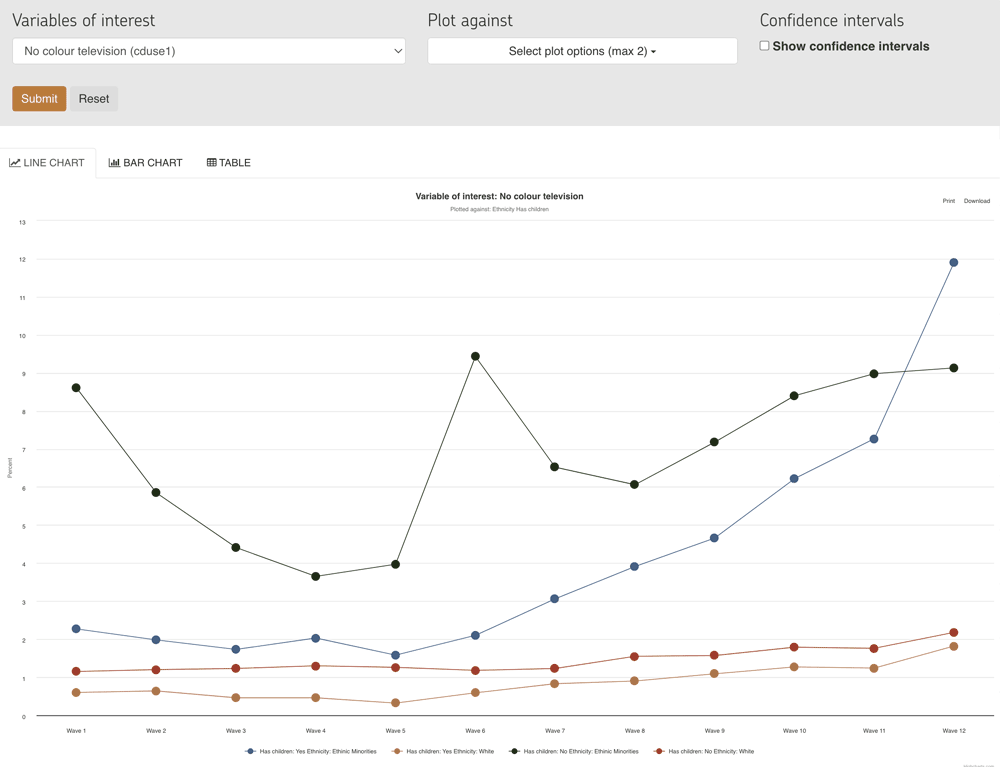
Which population groups are most affected by the rising cost of living? Use this tool to build charts to show trends over time and compare different groups. The data comes from the Understanding Society main survey where our participants answer questions about what they spend their money on and how they feel about their individual finances.
What data do Understanding Society collect?
Understanding Society asks questions about income and expenditure at the individual level. Questions on household income and expenditure are asked at each wave of the Study, allowing researchers to see year by year what happens to income and spending over time. The Study also asks questions about financial strain, household assets and spending. For income, questionnaires ask about job related earnings, unearned income and state benefits.
To give a broader picture of household finances we ask about wealth and debts and ask participants how they subjectively feel about their finances.
Some questions on finances are asked at specific ages, so younger people are asked about student loans and those aged over 40 are asked about retirement planning and pension drawdown.
Understanding Society also asks about financial behaviour and attitudes, including charitable giving, personal pensions, savings and child maintenance.
To find out about the specific questions asked in the Study use the index terms where you can search for finance variables including household income, rents, savings and investments and material wellbeing. The questionnaire modules show the areas covered in each wave of the Study and allow you to see the actual questions asked in the survey.
Derived income variables
Understanding Society collects detailed information at each wave on personal income. All individuals aged 16 and over are asked to report on their earnings from main and second jobs, social security benefits, state and private benefits, and private transfers and investment income. Derived from these survey reports of individual income from different sources are a number of variables corresponding to different income concepts. These can be measured at the individual or household level, net or gross, or with or without household level deductions. You can find information about using individual income variables and household income variables in the main survey user guide.
Using income data for policymaking
Understanding Society is used by the Department for Work and Pensions as the basis for the Official Statistic for Income Dynamics. This statistic presents information on changes in income over time and presents findings on persistent low income. Individuals are considered to be in persistent low income if they are in relative low income for at least three out of four consecutive annual interviews. The latest release on Income Dynamics is available from the DWP.
The Treasury has used Understanding Society data to gauge the impact of the Covid-19 pandemic on working household incomes. The Treasury used data from Understanding Society’s Covid-19 Survey to compare employment status, and any change in take-home pay, in May 2020 compared with February, before lockdown was introduced. They also calculated the probability of people at different earning levels losing their job, being furloughed, or seeing their earnings/profit drop, again using our Study. The Treasury document, Impact of COVID-19 on working household incomes: distributional analysis as of May 2020, showed that the government’s interventions were worth an average of around a fifth of incomes for working households, and reduced the scale of losses for working households by up to two-thirds.
Current research from the Understanding Society team
Our Economics Topic Champions Dr Paul Fisher (Topic Champion, Income), Professor Thomas Crossley (Topic Champion, Consumption and Expenditure) and Professor Hamish Low (Topic Champion, Economic Risks) regularly publish research using Understanding Society data. Find out about their latest research here.
Need help?
Visit our new user pathway to explore the data and online resources or contact the User Support forum if you have a question for the Study team.
Working Paper: Understanding Society and its income data
UKHLS contains a wide range of income variables and this paper documents the details of all of them.
Blog: Unaffordable housing is bad for our health
We know from previous research that the more unaffordable the housing, the worse people’s health is, but existing research has tended to use only one measure of unaffordability. In this blog researchers Will Raderman, Nina Rogers and Emily Murray share their work on measuring unaffordability that takes in to account where people are on the income distribution.
Briefing Note: COVID-19 Survey, the economic effects
Analysis of the size of the economic shocks associated with the coronavirus pandemic, how households mitigated these shocks and the consequences for individuals and households.
Podcast: The cost of living crisis
Who has been hit the hardest? And what can government do about it? Our guests are Professor Hamish Low, the James Mead Professor of Economics at the University of Oxford, and Rebecca McDonald, Chief Economist at the Joseph Rowntree Foundation.