Skip to content

Health and wellbeing

Health, exercise, sleep, mental wellbeing, nutrition, disability - Understanding Society collects information about participant's physical and mental health throughout their lives

Understanding Society produces high quality, longitudinal health data that helps researchers investigate people’s health within and across families over time and place. Our health data is used to inform policies which benefit the general health and wellbeing of the UK population. 
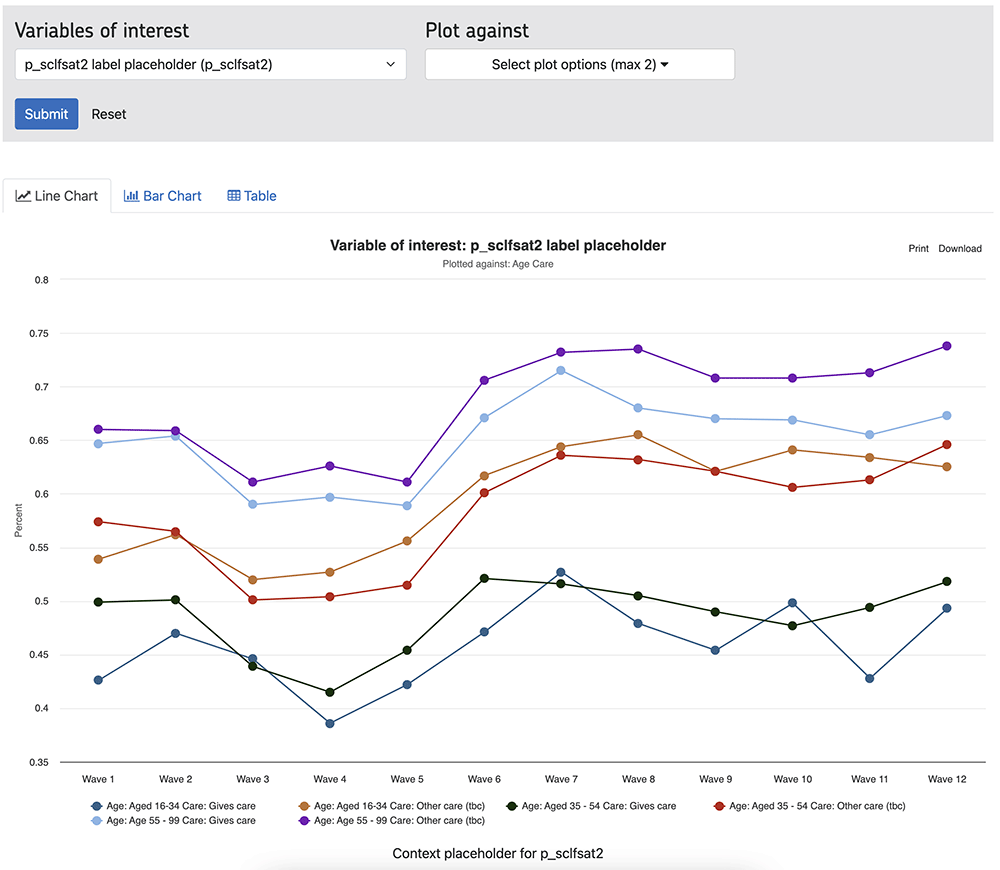
Wellbeing dashboard

Created in collaboration with the What Works Wellbeing Centre, use this dashboard to build and download charts to show trends in key wellbeing variables. How do wellbeing levels vary across time, population groups and regions? The dashboard uses data from the main Understanding Society survey where our participants answer a range of questions annually or less frequently on different aspects of wellbeing. 

Wellbeing dashvboard

What data do Understanding Society collect?

We collect information on general health, self-reported common health conditions and health behaviours (including alcohol, smoking, physical activity and diet) from the whole household.  

The Study uses validated health scales to collect information on: 

  • mental health (General Health Questionnaire-12) 
  • measures of wellbeing WEMWBS
  • quality of life, physical and mental health (SF-12) 
  • alcohol consumption (CAGE)
  • exercise (IPAQ)
  • children’s mental health (SDQ strengths and difficulties questionnaire) 

 We ask different age groups and demographics additional questions: 

  • Young adults 16-21 are asked about smoking, alcohol and recreational drug use.  
  • Children 10-15 complete a paper self-completion questionnaire about disability, nutrition, exercise, mental health, smoking and alcohol consumption.  
  • Women are asked about their health and behaviour during pregnancy, child birth, birth weight, breast feeding and early indicators of an infant’s health 
  • for children under 10 years, parents are asked about key development stages at ages 3, 5 and 8. For ease the PEACH data file brings this data together

Read the questionnaires to see all the topics

What can you do with these data?

Researchers can:

  • focus on the social determinants of health and health inequalities 
  • examine the economic (including employment) impacts of poor health 
  • use the Study to understand what shapes health-related behaviours
  • explore how public health policies affect health and wellbeing allowing comparisons of policy in the UK across England, Scotland, Wales and Northern Ireland 

Biomarkers, genetics and epigenetics

Physical health bio-medical measures (biomarkers) collected from 20,000 adults include blood pressure, weight, height, waist measurement, body fat, grip strength and lung function and DNA blood samples (genetic and epigenetic). If you are interested in these data please see the biomarker, genetics and epigenetics topic page

Tips for analysts

1

To find out about the variables in the Study use the index terms to search for health and wellbeing variables including health behaviour, subjective wellbeing and personal health condition.

2

The Variable search helps you find the variables you need for your research and shows which data file and questionnaire module it is in. 

3

The questionnaire modules show the areas covered in each wave of the Study and allow you to see the actual questions asked in the survey.

4

The Key variables highlight which variables will help you get started working with the political and social attitudes data. 

Need help?

Visit our new user pathway to explore the data and online resources or contact the User Support forum if you have a question for the Study team.

Blog: Is telephone triage helping patients with more than one condition?

Catherine Saunders, University of Cambridge, and Evangelos Gkousis, RAND Europe, look at how call for a GP appointment affects different groups.

Impact: Health in ‘left behind’ communities

The Northern Health Alliance used Understanding Society to assess mental health across the UK.

Video: Older people, seeing family, and mental health during the pandemic

Dr Yang Hu, Lancaster University, shares his research on how older people used technology during the pandemic and how the loss of real life contact increased mental health problems.

ISER Working Paper: The impact of a personalised blood pressure warning on health outcomes and behaviours

Exploring the impact of tailored health warnings on health outcomes.

Our Impact

The Children’s Society and Barnardo’s collaborated on a joint project using Understanding Society to investigate the predictive and protective factors for young people to have good mental health.

Public Health England is using Understanding Society as one of the sources for its mental health monitoring during the Covid pandemic.

Find out more about the impact Understanding Society has on policy, and about how you can work with us to provide evidence for decision-makers.


Find out more Work with us

Email newsletter

Sign up to our newsletter