Showing News articles for: Health and wellbeing View all News
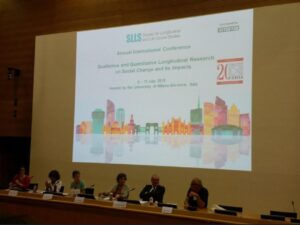
Eight new research papers which used data from Understanding Society and the British Household Panel Survey were presented at the eighth Society for Longitudinal and Lifecourse Studies (SLLS) conference.
Two charities will receive support through Understanding Society’s Research Voucher Scheme, which provides research guidance for policy relevant projects that use the Study’s data.
A new report which was developed using data from Understanding Society has found that participating in creative and cultural activities maintains our wellbeing as we get older.
People act less ‘green’ when they feel they don’t have a good work-life balance, according to new research using Understanding Society data.
The Joseph Rowntree Foundation used Understanding Society to measure poverty rates and trends across Wales.
For the first time in the Study’s history, data from the British Household Panel Survey (BHPS) has been harmonised with Understanding Society to create 25 years of longitudinal data.
Understanding Society has published its sixth Insights report, providing new findings for researchers and policy makers on the changes and stability in the lives of people in the UK.
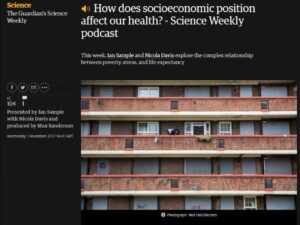
Meena Kumari, Professor of Biological and Social Epidemiology discusses her pioneering work combining biological markers from blood samples with the socio-economic longitudinal data collected from participants in Understanding Society, in a new podcast for The Guardian’s Science Weekly series.
New ISER research using Understanding Society data has suggested that health inequalities are larger between households than between individuals, highlighting the importance of targeting potential health policies at couples rather than individuals.
Funding is now available for Data Project Fellows who undertake social science projects that make use of Understanding Society’s biomarker, genetics or epigenetics data.
Adding 20 minutes more commuting time each day has the same effect on job satisfaction as taking a 19% pay cut, according to a new study using data from Understanding Society.
Does social mobility make it more difficult to maintain social relationships? Are people less likely to speak to their neighbours as they move in to a higher social class?
How men and women react to job loss largely depends on what attitudes a person has towards gender roles, says a new report which uses five years of data from Understanding Society.
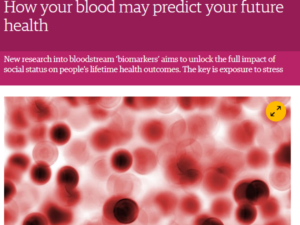
The Guardian has published an indepth feature on new research which uses Understanding Society’s biomarker data.
A study of the mental health of the LGB population has found that people who identified as gay, lesbian or bisexual experienced poorer mental health than heterosexual people. The research highlights the inequalities experienced by sexual minorities.
By observing the behaviour of 1,729 children aged 10 to 15 over time, researchers have found happiness and harm awareness could keep young people from drinking and smoking.
The Scottish county, East Dunbartonshire has been recognised as the top location to live in the UK if you’re a woman, according to new academic research.
One in three teenage girls is fearful of being followed by a stranger and one in four boys are worried they’ll be assaulted, new research from The Children’s Society reveals.
Flexibility in the workplace could be a key to helping women maintain their career trajectory after having children, new research using Understanding Society data suggests
Sign up to our newsletter
The Economic and Social Research Council is the primary funder of the study The Study is led by a team at the Institute for Social and Economic Research (ISER) at the University of Essex.