Showing News articles for: Young people View all News
Playing sport, learning to play a musical instrument or joining a drama group give children vital skills and the chance to socialise with different groups of people, but research from the Social Mobility Commission has found that whether children take part in these types of activity is heavily influenced by how much money their family has.
The Children's Society Good Childhood Report finds that young people are becoming less happy over time.
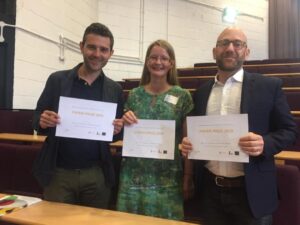
We presented four prizes at the Understanding Society Scientific Conference at the beginning of July
New research suggests social media use only has small, subtle effects on teenagers’ well-being.
New research has found that a good Ofsted rating can have a surprisingly negative impact on students.
Book your place at the 2019 Scientific Conference!
Young people today are feeling more distant from their family members and also from their close friends, according to the Index of Wellbeing from the Intergenerational Foundation.
Have a question about using Understanding Society? Discuss it directly with our User Support team during the online helpdesk hour.
UK-born grandchildren of immigrants tend to mirror the money-saving behaviour of their grandparents' country of birth, according to new research from the London School of Economics.
Have you used household panel data in your research? Understanding Society is accepting abstracts for its Scientific Conference which will be held on 2-4 July 2019.
The latest wave of data is now available to researchers.
If you have created syntax for the Understanding Society dataset you can now share it with other data users through our website.
Funded PhD Studentships working with the Understanding Society team are now open for applications.
The three new projects will focus on policy-relevant research.
A new edition of the Understanding Society Waves 1 - 7 dataset has been released today.
10 year olds who frequently argue with their mother are significantly more likely to develop mental health problems by the time they are 14, a new report from The Children’s Society and Barnardo’s has found.
Using five years of longitudinal data from Understanding Society, a new study has considered what affects 16-25 year olds’ chances of finding employment after leaving education.
By observing the behaviour of 1,729 children aged 10 to 15 over time, researchers have found happiness and harm awareness could keep young people from drinking and smoking.
Sign up to our newsletter
The Economic and Social Research Council is the primary funder of the study The Study is led by a team at the Institute for Social and Economic Research (ISER) at the University of Essex.