Skip to content

Young people

Home life, school work, friends, family, plans for the future. Children under 10 are included in their parent's survey. Young people aged 10-15 have their own survey about their life experiences, health and wellbeing

Understanding Society covers everyone in a household, so we ask questions about children and young people, as well as the adults. All young people aged 10 – 15 complete their own questionnaire and adults are asked about the children in their care. 
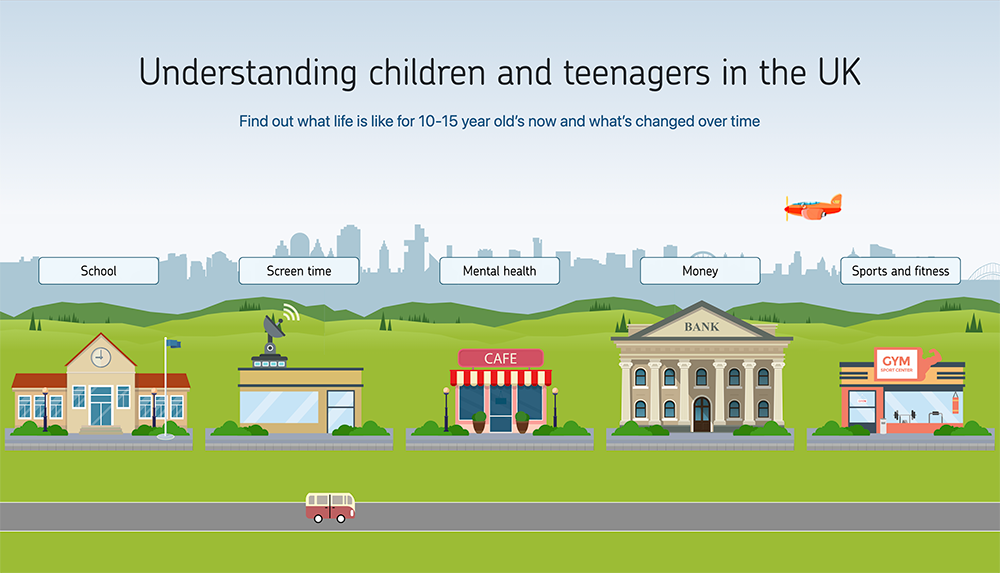
Youth data website

Check out our youth data website which reveals what life is like for 10-15-year olds now and what’s changed over time

Screenshot of the youth website homepage

What data do Understanding Society collect?

Young people aged 10-15 complete a self-completion questionnaire confidentially once their parent parent or carer has given permission for them to take part in the survey. When a young person turns 16 they move onto the adult survey.

The questionnaire asks them about their family relationships and home life, about how they see themselves as a person and how they feel about different aspects of their life. We ask about their school life, homework, any paid jobs that they have and their plans for the future. Also included are questions on their health and wellbeing.

What about younger children?

All parents of children under the age of 16 are asked about mother’s return to work plans, child care arrangements, how parents and children interact at home, parenting styles, non-resident parent relationships and child maintenance. 

They are also asked questions dependent on the child’s age.

We have brought these data together in one crosswave file Pregnancy and Early Childhood (PEACH) which gives key data reported by parents for all children aged under 10.

Young person’s ageType of QuestionnaireWho answers the questions
16Adult questionnaireYoung person
10-15Self-completion questionnaireYoung person
0-9Adult questionnaireParents or carers
0-9 age groupQuestions parents or carers are asked
0-1 Pregnancy and the first year after birthType of conception, outcome of pregnancy. For live births, the type of delivery, whether smoked or drank in different pregnancy trimesters. Due date, whether baby born early or late. GAINS scale basic development question about feeding and sleeping. 
3 years oldWhether the child has a long term health condition, a series of questions about learning physical and cognitive skills, behaviour and psychological wellbeing. 
5 and 8 years old How happy they are at school, risk aversion behaviours, strengths and difficulties.
3, 5 and 8 years old Parental reading with the child, regular meal and bed times.

What can you do with these data?

Researchers can: 

  • explore family circumstances, relationships, transitions, and changes over time, both within households and as individuals move out and form their own households
  • use the Family Matrix (xhhrel) data file to map familial relationships across the Study identifying connections between individuals and households
  • take advantage of the Study’s longitudinal design to track family generations over time, including data from the British Household Panel Survey (a subset of the Understanding Society sample), which dates back to 1991
  • use the Pregnancy and Early Childhood (PEACH) data file to investigate topics related to child development by using the rich information available on conditions before and after childbirth

You can find out how Understanding Society youth data has already been used by looking in our publications library. This search shows all the results for politcs and social attitudes publications. 

Tips for analysts

1

To find out about the variables in the Study use the index termsto search for children and young people variables including children, child care, family life and fertility 

2

The Variable search helps you find the variables you need for your research and shows which data file and questionnaire module it is in. 

3

The questionnaire modules show the areas covered in each wave of the Study and allow you to see the actual questions asked in the survey. 

4

Need help?

Visit our new user pathway to explore the data and online resources or contact the User Support forum if you have a question for the Study team.

Working Paper: Enhancing data around early life in Understanding Society: scientific opportunities and considerations

Professor Michaela Benzeval outlines the areas where Understanding Society is improving data on families.

Download

Understanding Society’s data on young people

Why young people are so important to the Study.

Relationships between children and their non-resident parents during Covid-19

Caroline Bryson on whether the relationships between children and their non-resident parent were affected during the early stages of the coronavirus pandemic.

Impact: ONS uses Understanding Society to help tackle bullying in schools

The Bullying Index show prevalence of bullying in schools and the impact on children’s wellbeing.

Our Impact

The Children’s Society report uses Understanding Society for its annual Good Childhood Report, which monitors the happiness of 10-15-year-olds.

A report from NatCen using our data has shown that mental health difficulties in childhood can significantly affect people’s education, relationships and future prospects.

Find out more about the impact Understanding Society has on policy, and about how you can work with us to provide evidence for decision-makers.


Find out more Work with us

Email newsletter

Sign up to our newsletter